

Gymnastics Mats and Safety Foam Modules
A mat protects, a module absorbs the impact. We cover fillers and densities, covers, thicknesses from 40 to 600 mm, and when a non-standard size is needed.
·6 min read
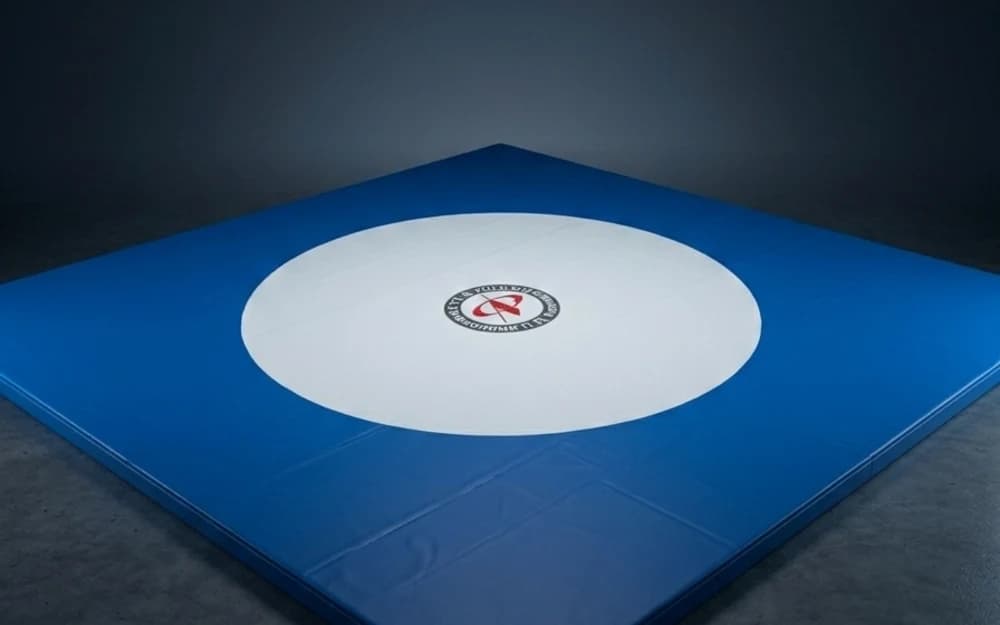
A gymnastics mat and a floor covering solve different problems, even though both are soft. A floor covering lies across the entire working area and is in use constantly. A mat is a separate item that you place wherever an exercise is taking place: under an apparatus, in a landing zone, or under a beginner who needs spotting. This explains the differences in construction: a mat has handles, hook-and-loop fasteners around the perimeter, and a cover that withstands carrying and washing.
Below, we explain how mats differ from one another, which filler suits which task, and when a safety foam module is needed instead of a mat.
Filler: PE foam or polyurethane foam
This is the first decision, and it determines everything else. PE foam is polyethylene foam: rigid and durable. Polyurethane foam is softer, compresses more deeply and costs less, but it also recovers less well.
| Filler | Density | Application |
|---|---|---|
| Standard PE foam | 140–150 kg/m³ | Basic training mats, school gyms, general physical conditioning |
| Economy PE foam | 160–170 kg/m³ | Higher density, anti-slip option available |
| Profi PE foam | 190–200 kg/m³ | Intensive loads, commercial gyms, anti-slip |
| Polyurethane foam 18 | 18 kg/m³ | Safety foam modules, landing zones |
| Polyurethane foam 25 | 25 kg/m³ | Reinforced modules for throwing practice |
Cover: PVC, Oxford or eco-leather
- PVC fabric is the standard for gyms: wear-resistant, washable and unaffected by sweat. It is chosen for schools and clubs where mats are used hard.
- Oxford is a strong synthetic fabric with a water-repellent treatment, lighter than PVC. It is convenient where mats are moved constantly.
- Eco-leather offers a premium look and pleasant texture for commercial studios. Minimum order: 5 pieces.
Size and thickness
The basic mat format is 1×2 m, 40 or 50 mm thick. This is enough for spotting during exercises, warm-ups and the school curriculum. When it comes to falls from a height or throws, forty millimeters is no longer enough, and safety foam modules come into play.
| Item | Thickness | Purpose |
|---|---|---|
| Gymnastics mat | 40 mm | Warm-up, general physical conditioning, spotting during exercises, school gym |
| Gymnastics mat | 50 mm | Acrobatics, intensive groups |
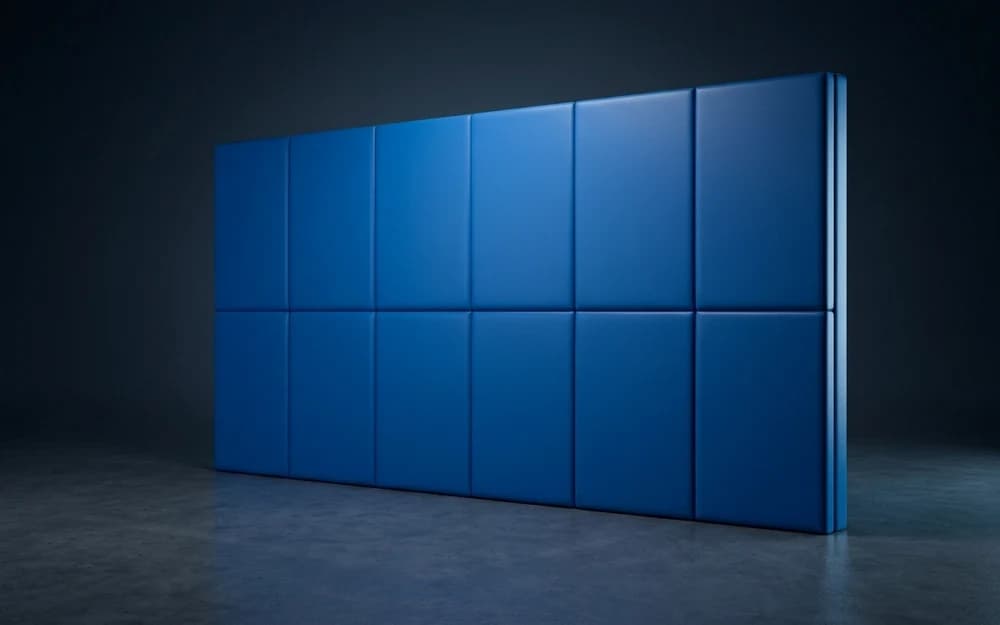
| Safety foam module | 100 mm | Practicing light throws, spotting beginners |
| Safety foam module | 200 mm | Working standard for sambo and judo |
| Safety foam module | 400 mm | High-amplitude throws, heavy weight classes |
| Safety foam module | 600 mm | Professional work and competition preparation |
Hook-and-loop fasteners run around the perimeter of mats and modules, so several items can be joined into a continuous landing zone with no gaps. This matters more than it seems: an open seam between two mats catches the foot at the very moment of landing.
When you need a module rather than a mat
The rule is simple: a mat spots, a module absorbs. If the athlete lands on the surface in a controlled manner, a mat is enough. If they fall from a full-force throw or land after flight, you need a module at least 200 mm thick; otherwise the energy goes into the body rather than the filler.
Modules do not replace a wrestling mat and are not laid in its place: they work locally, in the zone where a specific element is practiced. For guidance on choosing the main covering, see the article “Flooring for a martial arts gym”.
How much it costs
| Item | Size | Price from, ₽ |
|---|---|---|
| Gymnastics mat, PE foam, PVC cover | 1×2 m, 40 mm | 3 600 per mat |
| Profi PE foam mat with anti-slip, PVC | 1×2 m, 50 mm | 6 800 per mat |
| Safety foam module, polyurethane foam 18 | 1×2 m, 100 mm | 7 000 per module |
| Safety foam module, polyurethane foam 25 | 1×2 m, 600 mm | 28 200 per module |
Custom sizes and documents
Standard sizes cover typical tasks, but a gym is rarely typical: a jumping pit, a niche between uprights or a specific apparatus calls for its own size. Mats and modules are made to your dimensions. We manufacture in-house, in Dimitrovgrad, so a custom size does not require separate tooling. Send us the dimensions and the intended use, and we will select the filler and cover.
For purchases by a school, a youth sports school or a public-sector organization, a product passport for the mats and modules is attached to our offer. It is available in the section “Documents and certificates”, and the manager sends it together with the commercial quote.
What to send for a quote
- What happens on the mat: warm-up, acrobatics, throws, landings from a height.
- How many pieces you need and whether they will be joined into a single zone.
- Dimensions, if you need a custom size.
- Operating conditions: a school gym with daily use or a studio with a lighter regime.
- Gymnastics mats — fillers, covers, sizes
- Safety foam modules — 100, 200, 400 and 600 mm
- Catalog with filters
- Turnkey gym fit-out — if the gym is equipped in full
- Documents and certificates — product passports for procurement
Describe your task and send us the dimensions, and we will select the filler, cover and thickness and calculate the cost based on volume. We make custom sizes at our own production facility.
In brief: frequently asked questions
How does a gymnastics mat differ from gym flooring?+
Flooring stays in place across the entire work area, while a mat is placed only where an exercise is happening. That is why mats have carry handles, hook-and-loop fasteners around the perimeter for joining them into a zone, and a cover designed for washing and frequent moving.
Which filler is better: PE foam or polyurethane foam?+
They serve different purposes. PE foam is firmer and more durable, with a density of 140–200 kg/m³, and works underfoot and for spotting. Polyurethane foam at 18 and 25 kg/m³ compresses deeper and is used in safety foam modules, where a fall from height has to be absorbed.
What safety module thickness is needed for sambo?+
The working standard for sambo and judo is 200 mm. 100 mm is used for light throws and for spotting beginners, 400 mm for wide-amplitude throws and heavy weight classes, and 600 mm for professional training.
Can several mats be joined into one zone?+
Yes, mats and modules have hook-and-loop fasteners around the perimeter. Several pieces join into a continuous surface without gaps, which matters because an open seam can catch a foot on landing.
Do you make mats in custom sizes?+
Yes, mats and modules are made to your dimensions: for a jumping pit, a niche between uprights, or a specific apparatus. We manufacture in-house, so a custom size does not require separate tooling.
How much does a gymnastics mat cost?+
The wholesale price of a 1×2 m mat, 40 mm thick, with PE foam filler and PVC cover starts at 3 600 ₽. A PE-profi mat, 50 mm, with anti-slip finish starts at 6 800 ₽, and a 1×2 m safety module, 100 mm thick, starts at 7 000 ₽.