

Flooring for a Martial Arts Gym: How to Choose
Four types of flooring that any gym chooses from. We compare construction, thickness and price per square meter, and explain what to choose for each sport and each room.
·8 min read
Four types of flooring cover almost every need of a martial arts and combat sports gym: wrestling mats, tatami, budo mats and roll-out mats. They differ not in “quality” but in construction, and the choice should be based not on price per square meter but on what happens on the surface every day.
The short answer: if athletes wrestle and throw, you need a wrestling mat or tatami; if they work standing up and drill technique, budo mats are enough; if the flooring is cleared away and rolled out again every day, you need roll-out mats. Details and figures follow.
How they differ
| Wrestling mat | Tatami | EVA budo mats | Roll-out mats | |
|---|---|---|---|---|
| Construction | Mats under a single cover | Separate sheets | Separate puzzle mats | Roll, unrolled on site |
| Material | PE foam + PVC cover | Rebonded PU foam or PE foam | EVA | Rebonded PU foam + top covering |
| What is specified | density 150–200 kg/m³ | density 160–240 kg/m³ | hardness ~40 Shore | thickness and covering |
| Module | set of 18–72 mats | sheet 1×1 or 1×2 m | mat 1×1 m | roll 1.5 m wide |
| Thicknesses | 40 and 50 mm | 40 and 50 mm | 20, 25, 40 mm | 20, 30, 40, 50 mm |
| Visible seams | no, one continuous surface | yes | yes | only between rolls |
| Wrestling competitions | yes | judo, karate | no | no |
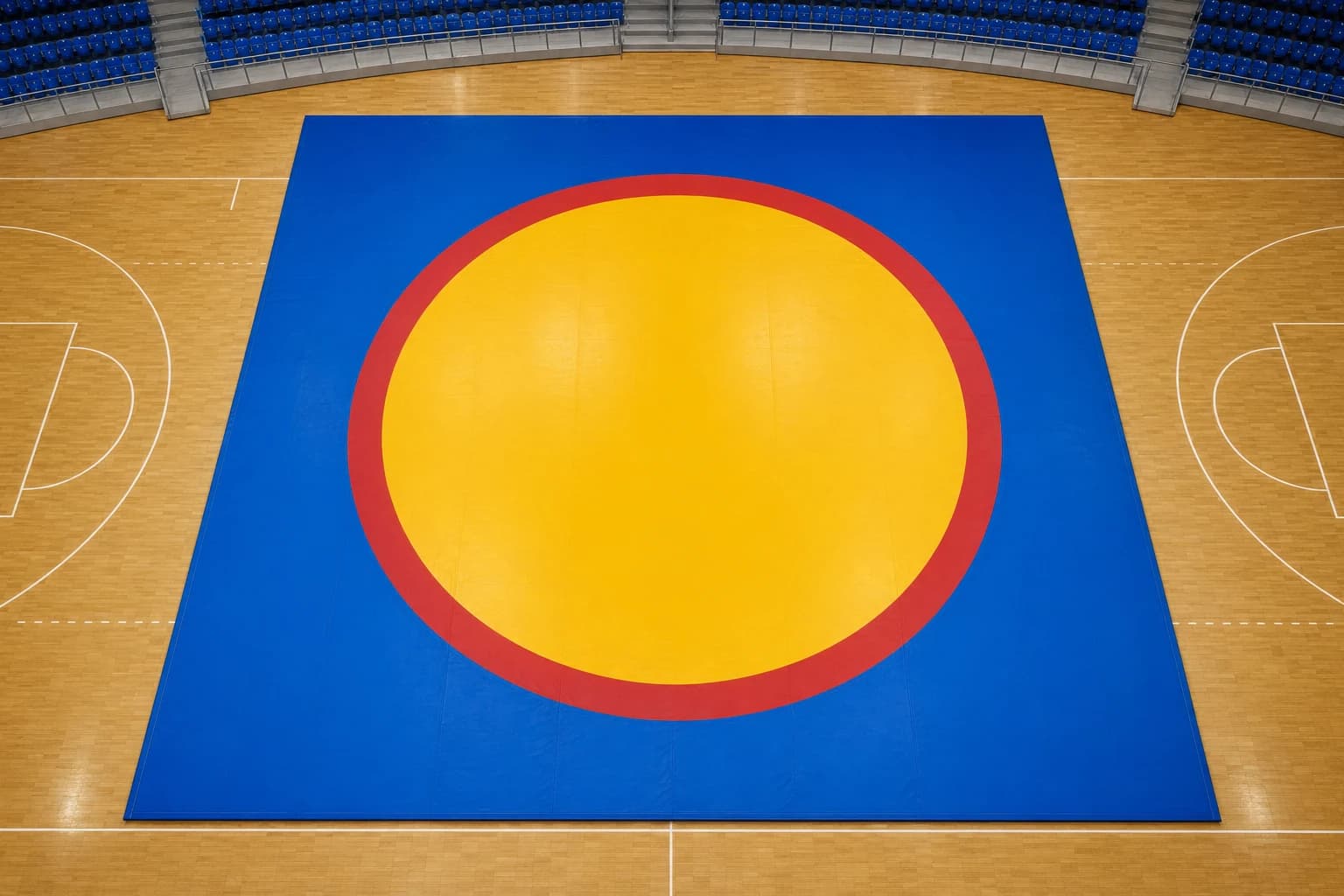
The main difference is the cover. On a wrestling mat, the mats are covered by a single sheet, so in ground work the body slides over a smooth surface and does not catch on edges. With tatami and budo mats each sheet is independent, and a seam remains a seam. That is acceptable for throwing practice, but not for competitive wrestling.
What to choose for each sport
| Sport | Flooring | Thickness |
|---|---|---|
| Sambo, combat sambo | Wrestling mat | 40 mm for training, 50 mm for competition |
| Freestyle and Greco-Roman wrestling | Wrestling mat | 50 mm |
| Judo | Tatami or wrestling mat | 40 or 50 mm |
| Karate, taekwondo | Tatami or budo mats | tatami 40 mm, budo mats 25 mm |
| MMA, grappling | Tatami | 40 mm |
| Children’s groups, general fitness | Budo mats | 20–25 mm |
| Gymnastics, acrobatics, warm-up | Roll-out mats | 20–40 mm |
For judo, the choice between a wrestling mat and tatami comes down to the format of the gym. A wrestling mat gives a continuous surface and a competition look; tatami is more convenient where the flooring is rearranged or the gym is shared between clubs. For more on thickness by discipline, see the article “Tatami sizes and thickness”.
What to choose for the purpose of the gym
Competition gym
There is no choice here: you need a wrestling mat of the required size with a cover and mats of the appropriate density. The FIAS technical specification for manufacturing sambo mats requires an average mat density of 180–200 kg/m³, which the STANDARD and PROFI lines meet. The training lines START and JUNIOR are not suitable for competitions, however tempting it is to save money.
Training gym of a club or youth sports school
A workable option is a START or JUNIOR wrestling mat 40 mm thick, or tatami. The flooring is laid over the entire working area, and where space allows, a safety margin is left around the perimeter. For guidance on choosing size and density, see the article “How to choose a wrestling mat”.
School or multipurpose gym
If one room hosts both volleyball and a martial arts club, a continuous wrestling mat gets in the way: it cannot be cleared in five minutes. Budo mats (assembled and taken apart by the coach) and roll-out mats (rolled up) work well here. Add gymnastics mats to them — the school curriculum will require them anyway.
How much a square meter costs
It is easier to compare by price per meter than by price per item — that way the options can be compared directly.
| Flooring | Price from, ₽/m² | How it is calculated |
|---|---|---|
| START wrestling mat 40 mm | about 1,140 | 6×6 m set (36 m²) from 40,970 ₽, mats and cover |
| EVA budo mats 20 mm | 1,130 | 1×1 m mat from 1,130 ₽ for volumes over 100 m² |
| EVA budo mats 40 mm | 2,170 | 1×1 m mat from 2,170 ₽ for the same volume |
| PE foam tatami 40 mm | about 2,290 | 1×2 m sheet from 4,570 ₽ |
| Roll-out mats 20 mm | 2,600 | price given directly per m² |
| Rebonded PU foam tatami 40 mm | about 2,980 | 1×1 m sheet from 2,980 ₽ |
The takeaway from the table is not obvious: a wrestling mat costs no more than budo mats per meter — even though the price includes the cover and its mats are twice as thick. The difference lies elsewhere: a wrestling mat is bought as a complete set from 36 m², while budo mats can be added one at a time. That is why a small gym with a “whatever we have right now” budget more often chooses mats, not because they are cheaper.
Common mistakes
- Thin flooring for throws. 20 mm budo mats get punched through to the floor during throwing practice. If the program includes falls onto the back, 40 mm is the minimum.
- Budo mats for competitions. Seams come apart under load and there is no continuous surface — this kind of flooring is not used at official wrestling events.
- Comparing the density of different materials. For tatami, density is specified in kg/m³; for EVA, Shore hardness. “200 kg/m³ versus 40 Shore” is a comparison of kilograms with degrees.
- Flooring right up to the edge of the gym area. A free margin is needed between the mat and the wall, otherwise the athlete slides into the wall. If there is no margin, the wall is covered with padding.
- Different thicknesses in one working area. A step appears at the joint, and that is a direct route to an ankle injury.
How to calculate your gym
- Measure the room and subtract the zones that will not be covered.
- Define the working area: for a competition mat the size is set by the rules, for a training mat it is determined by the gym area.
- Choose the flooring type by sport and by whether it needs to be cleared away.
- Specify the thickness based on the intensity of throwing practice.
- Check the walls next to the working area and add padding if necessary.
The fastest way is the gym calculator: it calculates the area, number of mats and cost for your dimensions.
- Wrestling mats — 4 lines, FIAS-licensed, All-Russian Sambo Federation (VFS), UWW
- Tatami — Rebonded PU foam and PE foam, densities 160–240 kg/m³
- EVA budo mats — 20, 25 and 40 mm, 6 colors
- Roll-out mats — roll-out flooring
- Gym calculator — calculation for your dimensions
Send us your gym dimensions and sport — we will select the flooring, calculate the area and quote a price based on volume. Manufactured in Dimitrovgrad, delivery across Russia.
In brief: frequently asked questions
How does a wrestling mat differ from tatami?+
In construction. A wrestling mat is a set of 18–72 mats under a single mat cover, which gives a continuous surface with no visible seams. Tatami is laid as separate 1×1 or 1×2 m sheets, each ready to use on its own. Competitive wrestling requires a wrestling mat; for a gym with a changing program, tatami is more convenient.
What flooring is needed for sambo?+
A wrestling mat: 40 mm mats for a training hall and 50 mm for competitions. The FIAS technical specification for manufacturing sambo mats requires an average mat density of 180–200 kg/m³, which the STANDARD and PROFI lines meet.
Can budo mats be used instead of a wrestling mat?+
For standing training, general fitness and children's groups, yes. For wrestling competitions, no: budo mats have no single mat cover, so the seams stay open and shift apart under load.
Which is cheaper: a wrestling mat or budo mats?+
Per square meter they are comparable: a START 6×6 m, 40 mm mat set costs from 40 970 ₽, or about 1 140 ₽ per m² including the mat cover, while a 20 mm EVA mat starts at 1 130 ₽ per m². The difference lies elsewhere: a wrestling mat is bought as a complete set, whereas budo mats can be added one at a time.
What flooring should you choose for a school gym?+
If the gym is multipurpose and the flooring has to be put away, choose budo mats or roll-out mats: the former interlock like a puzzle, the latter roll up. A continuous wrestling mat gets in the way of other activities in such a gym.
Is wall protection needed if there is already flooring?+
If a wall is closer than one meter to the working area, yes. Athletes regularly go off the mat, and without padding the impact is taken by the wall. Wall protection should be included in the same budget as the floor.