
Tatami size and thickness: how to choose for your discipline
Thickness determines how forgiving the flooring is in a fall, and sheet size determines how many seams the gym will have. We calculate both based on the discipline and area.
·6 min read
Tatami has two dimensions you need to decide on before ordering: sheet size and thickness. The first affects installation speed and the number of seams in the gym; the second determines how much the surface forgives in a fall. A mistake in thickness is the more costly one: a sheet can't be reworked, only replaced.
Sheet size: 1×1 or 1×2 meters
Standard formats are 1×1 m (1 m²) and 1×2 m (2 m²). The material determines what is available: rebonded PU foam comes in both formats, PE foam is made only in 1×2 m sheets, and EVA only in 1×1 m.
| Format | Sheet area | Advantage | Drawback |
|---|---|---|---|
| 1×1 m | 1 m² | Flexible layout in a non-rectangular gym; easy to rearrange and trim | Twice as many seams over the same area |
| 1×2 m | 2 m² | Fewer seams, faster installation, a more seamless-looking surface | Heavier to carry, harder to fit into narrow areas |
Rule of thumb: for a rectangular gym dedicated to one discipline, choose 1×2 m; for an irregularly shaped gym or a surface that is regularly taken up, choose 1×1 m.
Thickness by discipline
Thickness is chosen based on how often, and from what height, the body falls onto the surface. Striking work needs firm support, while throwing needs deep cushioning, and these requirements pull in opposite directions.
| Discipline | Thickness | Why |
|---|---|---|
| Karate, taekwondo, striking classes | 20–25 mm | Work is done standing: the foot needs firm support. On a thick, soft surface the foot sinks and stability is lost |
| MMA, mixed groups | 40 mm | A compromise: supports stance work, yet absorbs falls to the ground and throws |
| Judo | 40–50 mm | Throws are continuous and made from height. Below 40 mm, the cushioning reserve is insufficient |
| Freestyle and Greco-Roman wrestling | 40–50 mm | High-amplitude throws and groundwork. For competitions the surface is usually different: a continuous wrestling mat |
| Warm-up, general fitness, children’s groups | 20 mm | There are no falls from height; the surface is there for warmth, cleanliness and a non-slip finish |
What the Russian rules say
If a gym is being prepared for official competitions, dimensions stop being a matter of taste. The rules of the sport “judo,” approved by the Russian Ministry of Sport, state them directly:
- Mat size — 1×2 m or 1×1 m, made of compressed polymer materials. Mats must be firm and resilient enough to soften falls, and must be neither slippery nor too rough. These are exactly the formats in which tatami is produced.
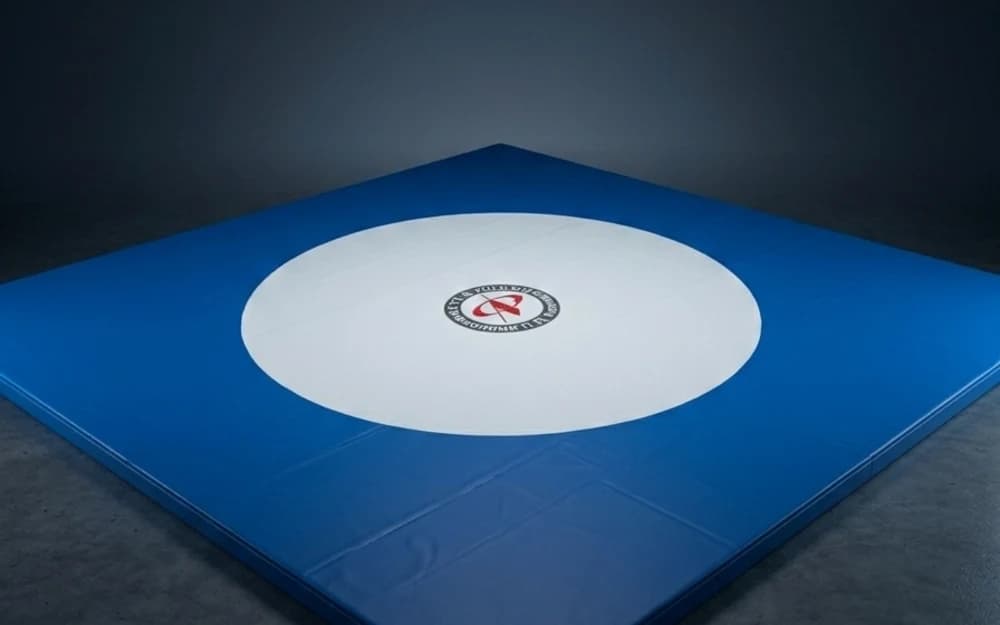
- Contest area — minimum 8×8 m, maximum 10×10 m. For all-Russian competitions, children under 11 and under 13 require at least 6×6 m, and under 15 and under 18 at least 7×7 m.
- Safety area — at least 3 m around the contest area; between adjacent areas, at least 4 m (3 m for younger age groups).
- Entire competition area — minimum 14×14 m, plus a free zone of at least 50 cm around the perimeter. For children’s all-Russian competitions — 12×12 and 13×13 m respectively.
The rules themselves do not specify thickness. It is given by GOST R 55669-2013 “Sports mats. Part 3. Mats for judo wrestling”, whose informative annex lists 40 or 50 mm with a thickness tolerance of ±3%. An important caveat: this standard does not apply to mats for international official competitions.
How to calculate the number of sheets
- Measure the area to be covered in meters and calculate its surface area.
- Divide the area by the sheet area: 1 m² for the 1×1 format and 2 m² for 1×2.
- Round up and add an allowance for trimming: 3–5% for a rectangular gym, up to 10% for complex geometry, columns and alcoves.
- If you need a safety zone in a different color around the perimeter, calculate it separately. For a training gym, the width is chosen to suit the room; for judo competitions, the rules require at least 3 m.
Example. A 10×10 m contest area is 100 m². That is 50 sheets of 1×2 m, or 100 sheets of 1×1 m. With a 5% allowance, 53 and 105 respectively. If the same area is prepared for competitions, a 3 m safety zone is added on each side, and the area grows to 16×16 m, or 256 m². It is easier to put together a complete calculation with pricing in the gym calculator: it accounts for both the surface and the related items.
What else affects your order
- Floor type. On a smooth base (laminate, tile, polished screed) you need a non-slip underside, “diamond” or “waffle”. On a rough screed, a plain underside is enough. For details on underside types, see the article “Tatami: what it is and what it’s made of”.
- Density. At the same thickness, a surface of 160 kg/m³ and one of 240 kg/m³ behave differently: the former is softer and wears faster, the latter is firmer and lasts longer.
- Color and zoning. The contest square and the safety zone are marked out with different colors, which is cheaper and more practical than painting markings.
- Tatami: full category — all materials and thicknesses
- 40 mm tatami for judo
- 50 mm tatami for judo
- 20 mm tatami for karate
- 40 mm tatami for MMA
- Roll-out mats — rolled surface for warm-up zones
Send us your gym dimensions and the sport: we will calculate the number of sheets, select the thickness and underside type for your floor, and quote a price based on volume.
In brief: frequently asked questions
What size is one tatami sheet?+
There are two formats: 1x1 m (1 m²) and 1x2 m (2 m²). The 1x2 m format gives half as many seams over the same area and is faster to lay, while 1x1 m is more convenient where the flooring is rearranged often or the room is not rectangular.
What tatami thickness is needed for judo?+
40 or 50 mm. These are the two values named in GOST R 55669-2013 for judo wrestling mats (informative annex, thickness tolerance ±3%). Thin 20–25 mm mats are not suitable for judo: they do not provide enough cushioning for a fall from a throw.
What area size is required for judo competitions?+
Under the sport's rules, the contest area is a minimum of 8x8 m and a maximum of 10x10 m, the safety area around it is at least 3 m, and the whole area is at least 14x14 m plus a free zone of at least 50 cm around the perimeter. For children's all-Russian events the dimensions are smaller: a contest area from 6x6 m and a total area from 12x12 m.
What thickness is needed for karate and MMA?+
Karate is mostly striking work, so the flooring needs support rather than deep cushioning: 20–25 mm is enough. For MMA, which combines striking, ground work and throws, a sensible compromise is 40 mm.
How do you calculate how much tatami a gym needs?+
Divide the zone area in square meters by the sheet area: 1 m² for the 1x1 format and 2 m² for 1x2. If the room is not rectangular, add an allowance for trimming along the perimeter. For an exact calculation with pricing, use the gym calculator.
Can different thicknesses be combined in one gym?+
Yes, if the zones are separate: for example, 40 mm in the throwing zone and 20–25 mm in the warm-up area. Within a single working zone the thickness must be the same, otherwise a step forms at the joint, which is a risk of injury.