

How to Choose Budo Mats: Thickness, Quantity and Price per Gym
The cheapest modular flooring for a club, and the most common place to get thickness wrong. We explain what EVA is, how the dovetail lock works, and when 20 mm is enough and when you need 40.
·7 min read
A budo mat is a modular EVA foam mat measuring 1×1 m that connects to its neighbors along the edges with a dovetail lock. The surface goes together like a puzzle: no glue, no mat cover, no fixing to the floor. That is also where the second name comes from, the one buyers search for most often: “dovetail mats”.
Strictly speaking, “budo” is the general Japanese term for martial arts, so the mat is named after its use, not its construction. In practice it is the surface with the lowest entry cost: a square meter of tatami costs two to three times more, and a wrestling mat is bought as a complete set starting from 36 m², whereas budo mats can be added one at a time.
What EVA is and why it is the material of choice
EVA is ethylene-vinyl acetate, a foamed polymer. Three properties make it the main material for modular mats:
- It does not absorb moisture. Sweat and water stay on the surface, the mat can be washed and dries quickly, and nothing grows inside.
- It holds the shape of the lock. The material is resilient, so the “dovetail” does not wear out after dozens of assemblies and disassemblies.
- It is light. One person can carry a 1×1 m mat, and a coach can set up a gym in an hour.
The hardness of EVA is measured not in kg/m³, as for tatami, but in units on the Shore scale. ROSSAMBO mats are around 40 units: soft enough to absorb a fall and firm enough that the foot does not sink in when standing. The top surface has a “rice straw” embossing, which gives grip for both bare feet and wrestling shoes.
20, 25 or 40 mm: how to choose the thickness
Thickness is the only parameter in this category where people really make mistakes. The logic is simple: the more often bodies fall onto the surface from a height, the thicker the mat needs to be.
| Thickness | Suitable for | What happens if you choose wrong |
|---|---|---|
| 20 mm | Warm-up, general physical training, children’s groups, fitness, areas around exercise machines, ground wrestling | On throws from height the mat “bottoms out” to the floor: 20 mm is not designed for falls on the back |
| 25 mm | A versatile option for a club: striking technique, basic throws, mixed groups | For a gym where full-force throwing practice happens every day, the margin is still not enough |
| 40 mm | Regular throwing practice, judo and sambo in training mode, adult groups | Too soft for purely striking disciplines: the foot sinks in slightly when standing |
A practical rule
- Standing work, strikes, general physical training, children: choose 20 mm.
- Mixed program, with throws that are not the core of the session: 25 mm.
- Throws every day, adult groups, judo and sambo: 40 mm.
- Wrestling competitions: budo mats are not suitable at all; you need a wrestling mat with a single mat cover.
How budo mats differ from tatami and from a wrestling mat
| EVA budo mats | Tatami | Wrestling mat | |
|---|---|---|---|
| Material | EVA | Rebonded PU foam or PE foam | Mats + mat cover |
| Module size | 1×1 m | 1×1 and 1×2 m | Set of 18–72 mats |
| Specified parameter | hardness ~40 Shore | density 160–240 kg/m³ | density 150–200 kg/m³ |
| Thicknesses | 20 / 25 / 40 mm | 20–50 mm | 40 / 50 mm |
| Continuous surface | no, seams are visible | no, seams are visible | yes, single mat cover |
| Wrestling competitions | no | judo, karate | sambo, judo, freestyle, Greco-Roman |
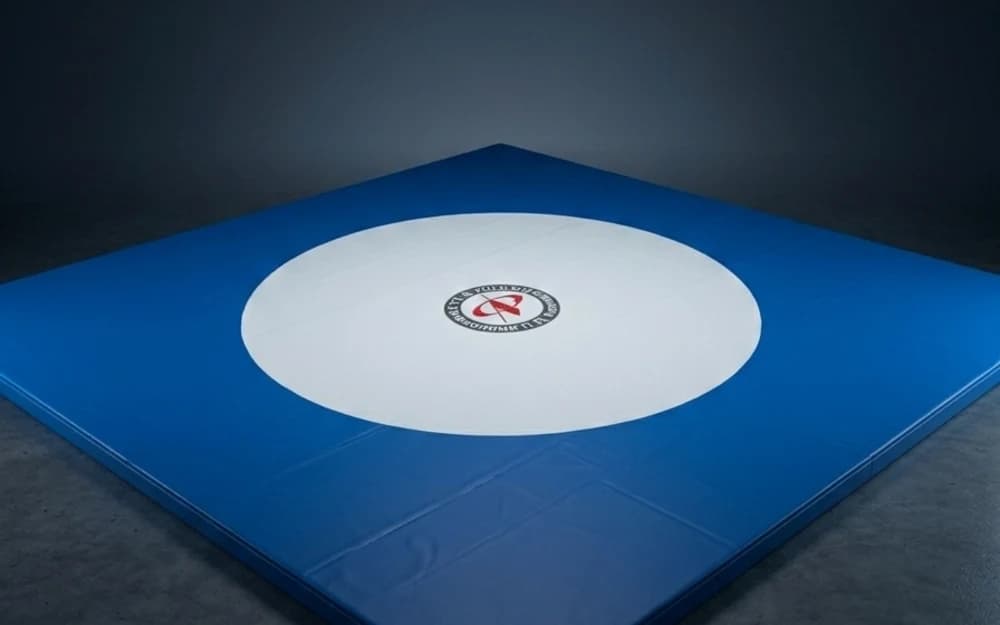
The main difference from a wrestling mat is the absence of a mat cover. Budo mats and tatami lie as separate sheets, and a seam remains a seam. A wrestling mat is covered with a single sheet, so you can wrestle on the ground without catching on the edges. For more on tatami materials, see the article “Tatami: what it is and what it is made of”, and for a full comparison of all four surfaces with prices per meter, see the article “Flooring for a martial arts gym”.
How many mats you need and how much it costs
The calculation is straightforward: one 1×1 m mat = 1 m², so a 10×12 m gym needs 120 mats. The wholesale price per mat starts from 1,200 ₽ for 20 mm, from 1,470 ₽ for 25 mm and from 2,280 ₽ for 40 mm, and from 100 m² a volume price applies: from 1,130, 1,400 and 2,170 ₽ respectively. Below is a guide for typical gyms at the minimum wholesale price.
| Gym | Mats | 20 mm | 25 mm | 40 mm |
|---|---|---|---|---|
| 6×6 m | 36 | 43,200 ₽ | 52,920 ₽ | 82,080 ₽ |
| 8×8 m | 64 | 76,800 ₽ | 94,080 ₽ | 145,920 ₽ |
| 10×12 m | 120 | 135,600 ₽ | 168,000 ₽ | 260,400 ₽ |
| 12×12 m | 144 | 162,720 ₽ | 201,600 ₽ | 312,480 ₽ |
How to order
- Send us the gym dimensions and the sport: we will select the thickness using the table above.
- Choose colors from the six standard ones (zone marking by color is described below).
- Receive a commercial quote with the number of mats and a price that accounts for volume.
There are six standard colors: red, blue, green, yellow, black and gray. They are usually used not for looks but to mark zones: the working square in one color, the safety zone around the perimeter in another.
- EVA budo mats: the full category — thicknesses, colors, prices
- 20 mm budo mats for schools — warm-up and general physical training
- 25 mm budo mats for youth sports schools — versatile option
- 40 mm budo mats for commercial gyms — throwing practice
- Catalog with filters
Send us the gym dimensions and the sport, and we will select the thickness, calculate the number of mats and quote a price that accounts for volume. Manufactured in Dimitrovgrad, delivered across Russia.
In brief: frequently asked questions
What are budo mats?+
A budo mat is a modular 1x1 m mat made of EVA foam that connects to neighboring mats like a puzzle. These mats let you build flooring of any area without a cover or glue, hence the second name, "dovetail mats," after the shape of the lock on the edge.
What budo mat thickness is needed?+
They come in 20, 25 and 40 mm. 20 mm suits warm-ups, general physical training, children's groups and fitness; 25 mm is a versatile option for clubs with striking and basic throws; 40 mm is for gyms where throwing work is constant and the flooring must cushion falls on the back.
How do budo mats differ from tatami?+
In material and construction. A budo mat is a single EVA sheet with a lock along the edge, with a hardness of about 40 Shore. Tatami is made from rebonded PU foam or PE foam, with specified density in kg/m³, a textured "rice straw" top layer and a choice of bottom finishes. Tatami costs more and performs more consistently, while budo mats are a budget modular solution.
How do budo mats differ from a wrestling mat?+
A wrestling mat is a set of 18–72 mats covered by a single cover, forming a continuous surface for competitive wrestling. Budo mats are laid as separate sheets without a shared cover, so the seams remain visible. Budo mats are not used for wrestling competitions.
How many budo mats are needed for a 10×12 m gym and how much do they cost?+
One 1×1 m mat covers 1 m², so a 10×12 m gym needs 120 mats. At the minimum wholesale price, that is from 135 600 ₽ for 20 mm, from 168 000 ₽ for 25 mm and from 260 400 ₽ for 40 mm. We calculate the exact amount, including color and volume, in a commercial quote.
Is there a volume discount?+
Yes, a separate price applies to orders of 100 m² or more. Wholesale mat prices start from 1 130 ₽ for 20 mm, from 1 400 ₽ for 25 mm and from 2 170 ₽ for 40 mm.