

Tatami: what it is, what it is made of and how it differs from a wrestling mat
The word comes from the Japanese home, but in a gym it means an entirely different product. We look at rebonded PU foam and PE foam, density, bottom types and what tatami is not.
·6 min read
A tatami in a sports hall and a tatami in a Japanese home are different products that share a name. The household tatami is a woven rice-straw mat with a fabric edging. The sports tatami is a modular surface made of foamed polymer; all it inherited from its ancestor is the surface texture that imitates woven straw.
The rest of this article covers only the sports tatami: what it is made of, what the density figures in the description mean, and how it differs from a wrestling mat and from budo mats, with which it is constantly confused.
What tatami is made of
Three materials are used in production. They are not interchangeable: each covers its own class of tasks and its own budget.
Rebonded PU foam — the main competition material
The top layer has a “rice straw” relief, with a foamed base underneath. Density is specified precisely for rebonded PU foam: 160, 180, 200, 220 or 240 kg/m³. Sheets come in two sizes, 1×1 and 1×2 m. This is the most “authentic” tatami: firm, stable, with a predictable response on a throw.
PE foam — the working standard for a training hall
Sheets of 1×2 m, 40 and 50 mm thick, including three-layer “sandwich” constructions in which a soft layer is held between two dense ones. This tatami is softer than rebonded PU foam at the same thickness and usually cheaper; it is the typical choice for youth sports schools and commercial gyms.
EVA — a budget option for children’s groups
The same material used to make budo mats: lightweight, water-resistant, with a dovetail lock. Thicknesses of 20, 25 and 40 mm, 1×1 m sheet. Ideal for children’s sections, fitness and warm-up areas; not suitable for competition throwing work.
| Material | Sheet size | Thicknesses | What is specified | Typical use |
|---|---|---|---|---|
| Rebonded PU foam | 1×1 and 1×2 m | 40 mm | density 160–240 kg/m³ | Judo, karate, aikido |
| PE foam | 1×2 m | 40 and 50 mm | density 190–200 kg/m³ | Training halls, schools |
| EVA | 1×1 m | 20 / 25 / 40 mm | hardness ~40 Shore | Children’s sections, clubs, fitness |
What tatami density means
Density in kg/m³ is the mass of material per cubic meter. In practical terms, it tells you how much the surface compresses under load and how quickly it returns to its original shape. The higher the density, the firmer the tatami and the longer it keeps its geometry under daily use.
- 160–180 kg/m³ — softer, more comfortable in a fall, wears out faster. Training groups, schools, children.
- 200–220 kg/m³ — the working range for a hall with constant use: it holds its shape but remains cushioning.
- 240 kg/m³ — the firmest option. Intensive use, minimal deformation over time.
It is worth understanding the status of these figures: tatami density is not specified by the rules of any sport or by a GOST standard, which set requirements for shock absorption, resilience and friction. Kg/m³ is a material characteristic given by the manufacturer, useful for comparing surfaces with one another, not an industry standard.
Why tatami has different bottoms
The underside of a rebonded PU foam sheet comes in four types, and it is chosen not by price but by what the surface will be laid on:
- Open bottom — the basic option. Suitable for a rough base: a concrete screed or a self-leveling floor with a matte finish.
- Cotton fabric — an interlayer that reduces sliding and protects the base.
- “Diamond” and “waffle” anti-slip — a textured bottom with maximum grip. Needed on a smooth floor: laminate, tile, polished screed.
A mistake with the bottom does not show up right away: after a few weeks the surface starts to “creep” under load, the joints open up, and the lock wears out. So tell your manager the type of base before ordering.
How tatami differs from a wrestling mat
These are two fundamentally different products, not two names for the same one:
| Tatami | Wrestling mat | |
|---|---|---|
| Construction | Separate sheets with a ready working surface | A set of mats under a single cover |
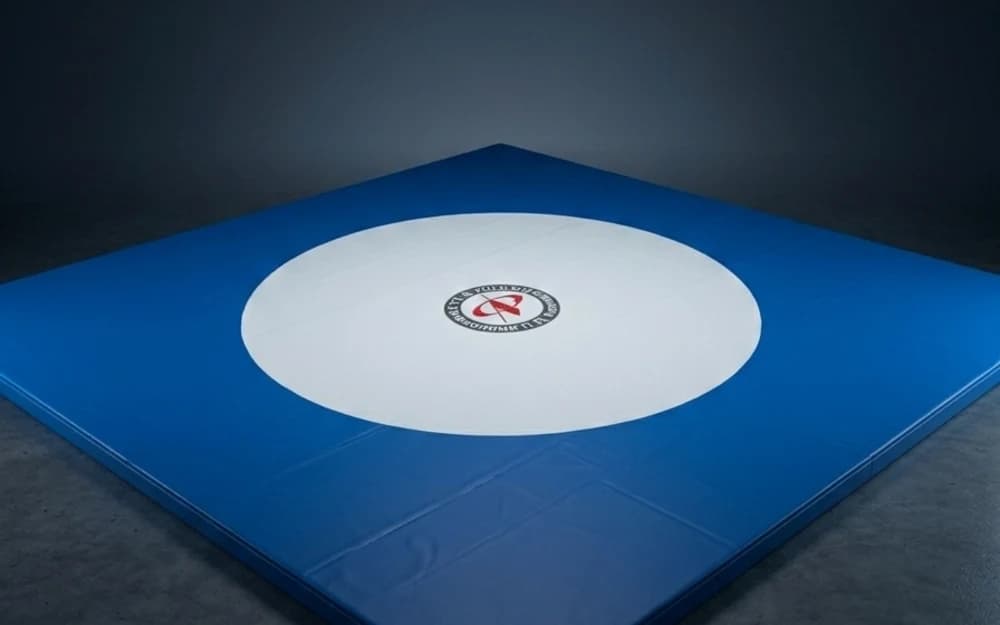
| Size | 1×1 or 1×2 m sheet, area is built up | Ready-made square from 6×6 to 12×12 m |
| Joints | Visible, the surface is modular | Hidden under the cover, continuous surface |
| Rearranging | Easy, done by the gym’s own staff | Requires removing the cover |
| Suitable sports | Judo, karate, aikido, MMA | Sambo, judo, freestyle and Greco-Roman wrestling |
If the hall is used for ground wrestling and competitions, you need a mat: on a modular surface a joint can catch. If the hall is multifunctional and the surface is periodically removed, choose tatami.
How much tatami costs
Wholesale prices start from 2,980 ₽ per 1×1 m rebonded PU foam sheet and from 4,570 ₽ per 1×2 m PE foam sheet. EVA is cheaper: from 1,130 ₽ per mat. The spread within a single material comes from density, sheet size and bottom type; all else being equal, each step up in density and each grippier underside adds to the price.
- Tatami — the full category — Rebonded PU foam, PE foam, EVA, all thicknesses
- 40 mm tatami for judo
- 25 mm tatami for karate
- EVA budo mats — budget alternative
- Wrestling mats — if you need a continuous surface
Not sure which material suits your gym? Tell us the sport, the area and the floor type, and we will select the tatami and calculate the set with a volume discount.
In brief: frequently asked questions
What is tatami?+
In martial arts and combat sports, tatami is a modular floor covering made of foam polymer with a non-slip textured top. Classic Japanese tatami made of rice straw has nothing to do with sport: all that remains is the characteristic surface texture, which is reproduced on the top layer.
What is tatami made of?+
There are two main materials. Rebonded PU foam is used for the top layer with a "rice straw" relief, in densities of 160, 180, 200, 220 or 240 kg/m³, in 1x1 and 1x2 m sheets. PE foam comes in 1x2 m sheets 40 and 50 mm thick, including three-layer "sandwich" versions. Children's clubs and fitness studios use a third material: EVA.
What does tatami density mean?+
Density in kg/m³ shows how much material there is per unit of volume and determines firmness and wear. 160–180 kg/m³ suits training groups and schools, 200–220 suits gyms with constant load, and 240 is the firmest option for intensive use.
How does tatami differ from a wrestling mat?+
Tatami is laid in sheets, each of which is a standalone product with a ready working surface. A wrestling mat is a set of mats under a single cover that forms one continuous surface. Tatami is more convenient for gyms where the flooring is rearranged from time to time; the wrestling mat is the competition format for sambo and wrestling.
What are tatami bottom types?+
The underside of a sheet can be open, covered with cotton fabric, or have an anti-slip relief, such as "diamond" or "waffle". The bottom affects how well the flooring stays in place: on a smooth screed or laminate you need an anti-slip underside, while on a rough floor an open one is enough.